
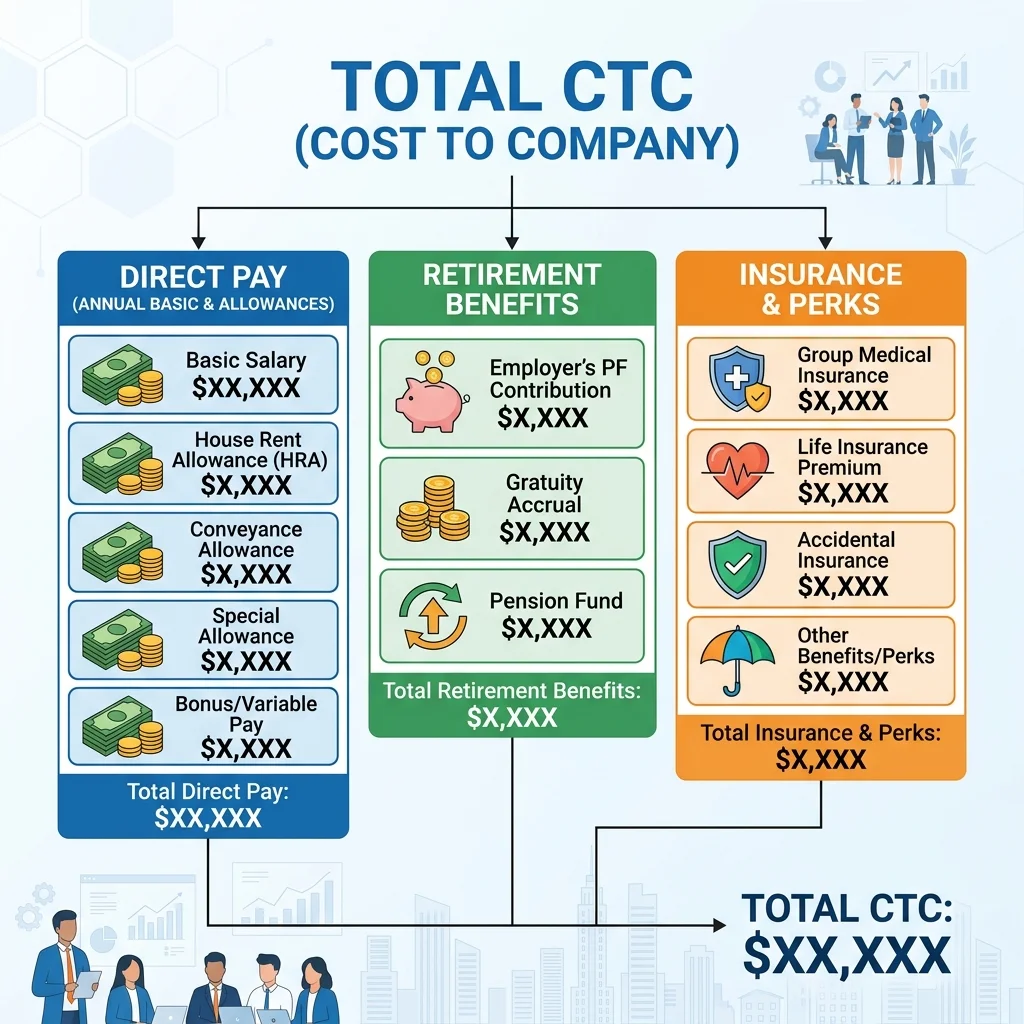
Cost to Company (CTC) is the total annual amount an employer spends to hire and retain an employee. It includes direct salary (basic, allowances), indirect benefits (PF contributions, gratuity, medical insurance), and variable performance bonuses.
Introduction: The Cost to Company Concept
During job interviews and offer discussions in India, the most common term used is CTC, which stands for Cost to Company. However, many freshers and even experienced professionals mistakenly assume that their CTC is the amount they will receive in their bank account every month. This leads to confusion when their first paycheck arrives.
This article explains what CTC actually means, breaks down its core components, and clarifies common misconceptions using standard guidelines from the EPFO and Income Tax Department.
The General CTC Formula
CTC is the total financial cost an employer incurs on you. The general formula is:
CTC = Direct Salary (Gross) + Indirect Benefits + Retirals (EPF/Gratuity) + Variable Bonuses
Core Components of a CTC Structure
An offer letter is divided into several sections that construct the total CTC:
1. Direct Pay / Gross Salary
- Basic Salary: The core component of your pay, typically 40-50% of your CTC. It is fully taxable and forms the basis for EPF calculations.
- House Rent Allowance (HRA): Provided to cover rent expenses. It is partially tax-exempt under Section 10(13A) of the Income Tax Act.
- Special Allowance: A taxable balancing component used to adjust the total package.
2. Retirals & Employer Contributions
- Employer EPF Contribution: The employer's mandatory 12% contribution to your Provident Fund account.
- Gratuity Accrual: A statutory benefit paid after 5 consecutive years of service, accrued annually in the CTC at 4.81% of your Basic salary.
3. Indirect Benefits & Perks
- Group medical insurance premium paid by the company.
- Free meals, transport facilities, or gym memberships.
Sample CTC Breakdown Table
| Salary Component | Monthly Value (₹) | Annual Value (₹) | Component Type |
|---|---|---|---|
| Basic Salary | ₹40,000 | ₹4,80,000 | Direct Pay (Taxable) |
| House Rent Allowance (HRA) | ₹16,000 | ₹1,92,000 | Direct Pay (Partially Exempt) |
| Special Allowance | ₹14,000 | ₹1,68,000 | Direct Pay (Taxable) |
| Employer EPF Contribution | ₹4,800 | ₹57,600 | Retiral (Deducted from CTC) |
| Gratuity Accrual (4.81% of Basic) | ₹1,924 | ₹23,088 | Retiral (Deducted from CTC) |
| Total CTC Offer | ₹76,724 | ₹9,20,688 | Cost to Company |
Frequently Asked Questions
What does CTC stand for in salary offers?
CTC stands for Cost to Company. It represents the total annual expenditure an employer incurs on hiring and retaining an employee, including salary, benefits, insurance, and retirement contributions.
Is CTC the same as in-hand salary?
No. CTC is the total cost to the company, whereas in-hand salary is the actual cash credited to your bank account after deducting EPF contributions, professional tax, and income tax (TDS).
Why is gratuity included in the CTC if I might not stay for 5 years?
Employers include gratuity in the CTC because it is a statutory liability they must fund. Even if you leave before 5 years and do not receive it, the company still accounts for the annual accrual in your package.
Is the employer's PF contribution part of my CTC?
Yes. Almost all companies in India include the employer's 12% EPF contribution inside the offered CTC package, which is then deducted from your monthly gross pay.
What is a Special Allowance in a salary slip?
Special Allowance is a taxable balancing component used by HR to make up the difference between the sum of structured allowances (Basic, HRA) and the total offered gross salary.
Are variable bonuses included in the CTC?
Yes. Many companies include performance-linked variable bonuses inside the total CTC package, which are paid out only if specific business and individual targets are met.
Senior Career Strategist & compensation analyst with 10+ years of recruitment research experience.
View Insights Home →