
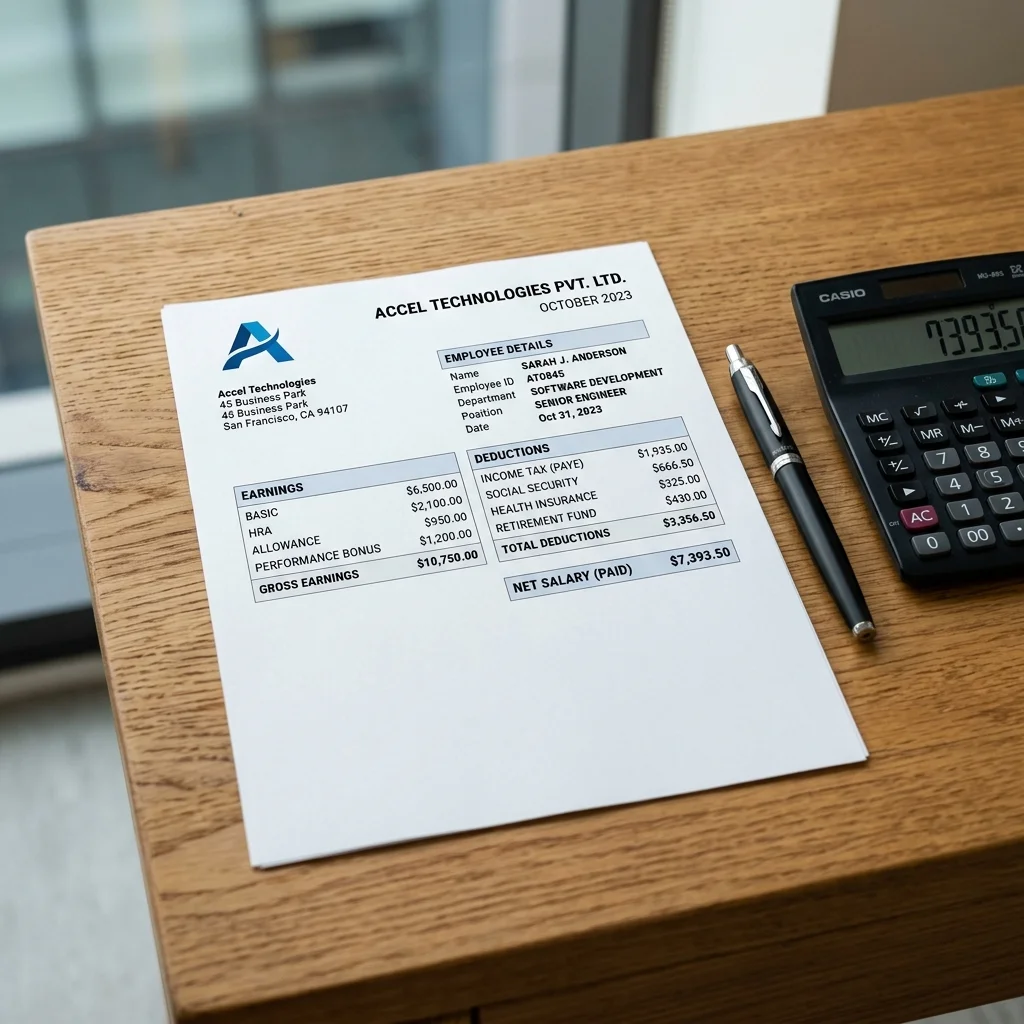
A salary slip has two main parts: Earnings (Basic, HRA, Special Allowance) and Deductions (EPF employee share, Professional Tax, TDS). Understanding both sections helps you monitor your take-home pay and tax declarations.
Introduction: The Importance of Your Pay Slip
Your monthly salary slip is a valuable financial document. It serves as proof of employment, is required for loan and visa applications, and details exactly how your earnings are structured and taxed. Yet, many people only look at the final net salary credited to their account.
This guide explains how to read and analyze both the earnings and deductions columns of your pay slip, following standard Indian payroll guidelines.
The Earnings Column (What You Earn)
This side lists the different components of your cash compensation:
- Basic Salary: The core taxable component, which forms the basis for PF calculations.
- House Rent Allowance (HRA): Paid to cover renting costs. You can claim tax exemptions on this by submitting rent receipts.
- Leave Travel Allowance (LTA): Provided to cover domestic travel costs (tax-exempt twice in a block of four years).
- Special Allowance: A fully taxable component added to meet the total gross salary offering.
The Deductions Column (What Is Taken Out)
This side lists the statutory and tax deductions made by your employer:
- Employee Provident Fund (EPF): Your mandatory 12% contribution to your retirement savings.
- Professional Tax (PT): A state tax on salaried employment, capped at ₹2,500 annually in India.
- Tax Deducted at Source (TDS): Estimated monthly income tax deducted based on your annual investment declarations.
Sample Salary Slip Layout
| Earnings (Left Column) | Amount (₹) | Deductions (Right Column) | Amount (₹) |
|---|---|---|---|
| Basic Salary | ₹40,000 | Provident Fund (EPF) | ₹4,800 |
| House Rent Allowance (HRA) | ₹16,000 | Professional Tax (PT) | ₹200 |
| Conveyance Allowance | ₹1,600 | TDS (Income Tax) | ₹3,500 |
| Special Allowance | ₹12,400 | Other Deductions | ₹0 |
| Gross Earnings | ₹70,000 | Total Deductions | ₹8,500 |
| Net Take-Home Salary (Gross - Deductions) | ₹61,500 | ||
Frequently Asked Questions
Why is my salary slip important?
Your salary slip is an official document required for opening bank accounts, applying for credit cards, securing home or personal loans, and filing income tax returns.
What is Basic Salary on a salary slip?
Basic Salary is the core component of your compensation structure. It is fully taxable and serves as the base for calculating other allowances and PF contributions.
How does HRA help in saving tax?
Under Section 10(13A) of the Income Tax Act, you can claim tax exemptions on HRA by submitting proof of rent payments and your landlord's PAN card to your employer.
What is TDS on a salary slip?
TDS stands for Tax Deducted at Source. It is the estimated income tax deducted from your monthly earnings and deposited with the Income Tax Department on your behalf.
Why is there a Professional Tax deduction on my slip?
Professional tax is a state-level tax levied on salaried professionals. It is deducted monthly by your employer and paid to the state government, capped at ₹2,500 per year.
How can I check if my PF deduction is deposited?
You can check if your PF deductions are deposited by logging into the EPFO Member Portal and viewing your EPF passbook, which lists all monthly transactions.
Senior Career Strategist & compensation analyst with 10+ years of recruitment research experience.
View Insights Home →