
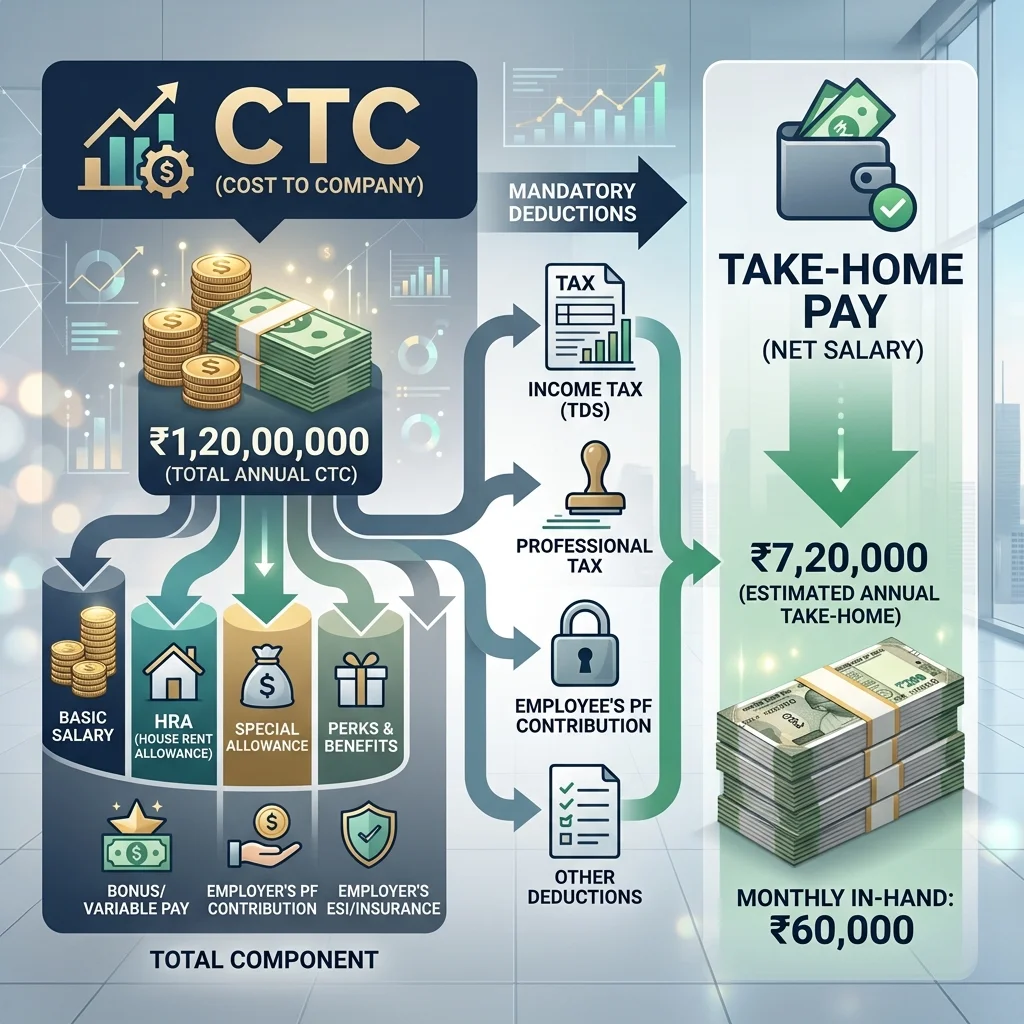
CTC represents the entire annual expense of hiring an employee, while in-hand salary is the actual monthly cash credited to your bank account after subtracting EPF contributions, state professional taxes, and income tax (TDS).
Introduction: The Offer Letter vs. The Bank Account
When you are looking for a job, recruiters often highlight the CTC (Cost to Company) to make the offer sound as large and attractive as possible. However, signing an offer based solely on the CTC figure without checking the take-home pay is a major career mistake.
This article provides an honest reality check on CTC vs. In-Hand salary, using real-world examples to show how deductions impact your paycheck, based on standard guidelines from the Income Tax Department.
The Structural Difference
- CTC (Cost to Company): The total annual expenditure incurred by the employer on the employee. This includes future retirement funds, health insurance premiums, and perks.
- In-Hand Salary: The actual liquid cash deposited into your bank account on the last day of the month.
A Real-World Example
Let's compare two offers of ₹12 Lakhs Per Annum (LPA) with different CTC structures to see how they affect your take-home pay.
| Component | Company A (High Take-Home) | Company B (Low Take-Home) |
|---|---|---|
| Total CTC | ₹12,00,000 | ₹12,00,000 |
| Fixed Base Salary | ₹11,00,000 | ₹8,00,000 |
| Variable Performance Bonus | ₹50,000 | ₹2,50,000 |
| Employer PF & Gratuity Inclusions | ₹50,000 | ₹1,50,000 |
| Estimated Monthly Net Take-Home | ~₹80,000 | ~₹56,000 |
As you can see, even though both companies offer a CTC of ₹12 LPA, Company A pays nearly ₹24,000 more in cash every month because it has lower variable pay and fewer non-cash inclusions.
Frequently Asked Questions
Why is there a difference between CTC and in-hand salary?
The difference exists because CTC includes non-cash benefits, retirement contributions (EPF, Gratuity), and variable bonuses that you do not receive in cash monthly, while take-home pay is calculated after taxes and deductions.
How much of my CTC will I actually get in-hand?
Typically, your monthly take-home salary is about 70% to 80% of your monthly CTC. The exact percentage depends on tax brackets, PF contributions, and the variable component in your offer.
Does a higher CTC always mean a higher monthly salary?
No. An offer with a lower CTC but a higher fixed component can pay more monthly cash than an offer with a higher CTC that includes large variable bonuses and non-cash perks.
What is the difference between fixed pay and variable pay?
Fixed pay is the guaranteed salary you receive every month, whereas variable pay is performance-linked and paid out periodically based on individual or company achievements.
Are joining bonuses part of the CTC?
Yes, companies usually include one-time joining bonuses in the first-year CTC to make the offer look larger, even though it will not be paid in subsequent years.
How does the tax regime affect my in-hand salary?
The New Tax Regime offers lower tax rates but no deductions, which can increase in-hand salary for mid-income earners who do not make tax-saving investments.
Senior Career Strategist & compensation analyst with 10+ years of recruitment research experience.
View Insights Home →