
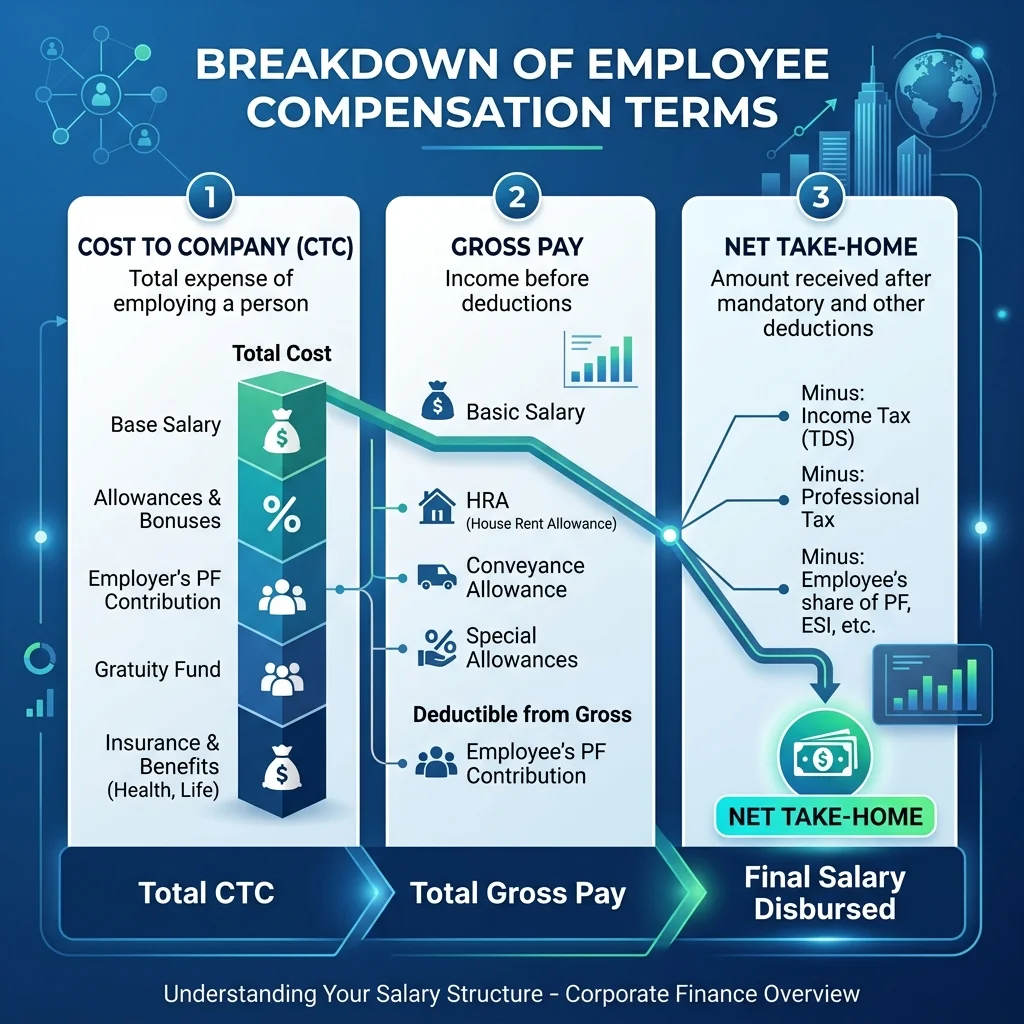
CTC is the total cost spent by the employer. Gross Salary is the earnings before taxes and employee PF deductions. Net Salary (take-home) is the final amount deposited into the bank account after all deductions.
Introduction: Defining the Three Salary Terms
Understanding corporate compensation in India requires knowing three key terms: CTC, Gross Salary, and Net (or In-Hand) Salary. These figures are often used interchangeably, but they represent very different values on your pay stub.
This article explains these terms, how they relate to one another, and how they are calculated using a real-world example, referencing rules from the Income Tax Department.
Defining the Terms
1. Cost to Company (CTC)
The total annual cost of hiring you. It includes your salary, employer PF contributions, gratuity, insurance premiums, transport facilities, and other perks.
2. Gross Salary
Your total earnings before any deductions (like employee PF, professional tax, or income tax) are made. It is calculated by subtracting employer PF and non-cash perks from the CTC:
Gross Salary = CTC - Employer PF - Gratuity - Non-Cash Perks
3. Net Salary (Take-Home Pay)
The final cash deposited into your bank account. It is calculated by subtracting your tax liability (TDS), employee PF share, and Professional Tax from your Gross Salary:
Net Salary = Gross Salary - Employee PF - Professional Tax - Income Tax (TDS)
Step-by-Step Calculation Example
Here is how a CTC of ₹6,00,000 (Annual) breaks down into Gross and Net monthly values:
| Step | Description | Annual Value (₹) | Monthly Value (₹) |
|---|---|---|---|
| 1. CTC Package | Total Cost to Company | ₹6,00,000 | ₹50,000 |
| 2. Deduct Employer PF & Gratuity | Statutory retirement inclusions | -₹35,000 | -₹2,917 |
| 3. Gross Salary | Your gross earnings | ₹5,65,000 | ₹47,083 |
| 4. Deduct Employee PF & PT | Provident fund and state taxes | -₹25,800 | -₹2,150 |
| 5. Deduct Income Tax (TDS) | Tax based on tax slab | -₹12,00,0 | -₹1,000 |
| 6. Net Take-Home Salary | Cash deposited in your bank | ₹5,27,200 | ₹43,933 |
Frequently Asked Questions
What is the main difference between Gross and Net salary?
Gross salary is your total earnings before any deductions, whereas Net salary (take-home pay) is the final amount credited to your bank account after deducting PF, professional tax, and income tax (TDS).
Is PF deducted from Gross or Net salary?
PF is deducted from your Gross salary. The deducted amount is deposited into your EPF account, and the remaining amount (after taxes) forms your Net salary.
What deductions are made from Gross Salary to get Net Salary?
The primary deductions are the employee's share of EPF (12% of basic), Professional Tax (state-level tax), and Income Tax (TDS) deducted by the employer.
Is HRA included in Gross Salary?
Yes. House Rent Allowance (HRA) is a part of your gross earnings and is included in your Gross salary, though it can be exempt from income tax calculations.
What does "take-home salary" mean?
"Take-home salary" is the common term for Net salary. It is the actual amount of liquid cash you receive in your bank account every month.
How does a bonus affect my Gross Salary?
When a bonus is paid out, it is added to your earnings for that month, increasing both your Gross Salary and your tax liability (TDS) for that period.
Senior Career Strategist & compensation analyst with 10+ years of recruitment research experience.
View Insights Home →